
Is Lane Splitting Legal A Complete State-by-State Guide for Riders
Disclaimer: This article is for informational purposes only and is not to be construed as legal advice. No attorney-client relationship exists based on the review of this article, and none of the information provided constitutes legal advice.
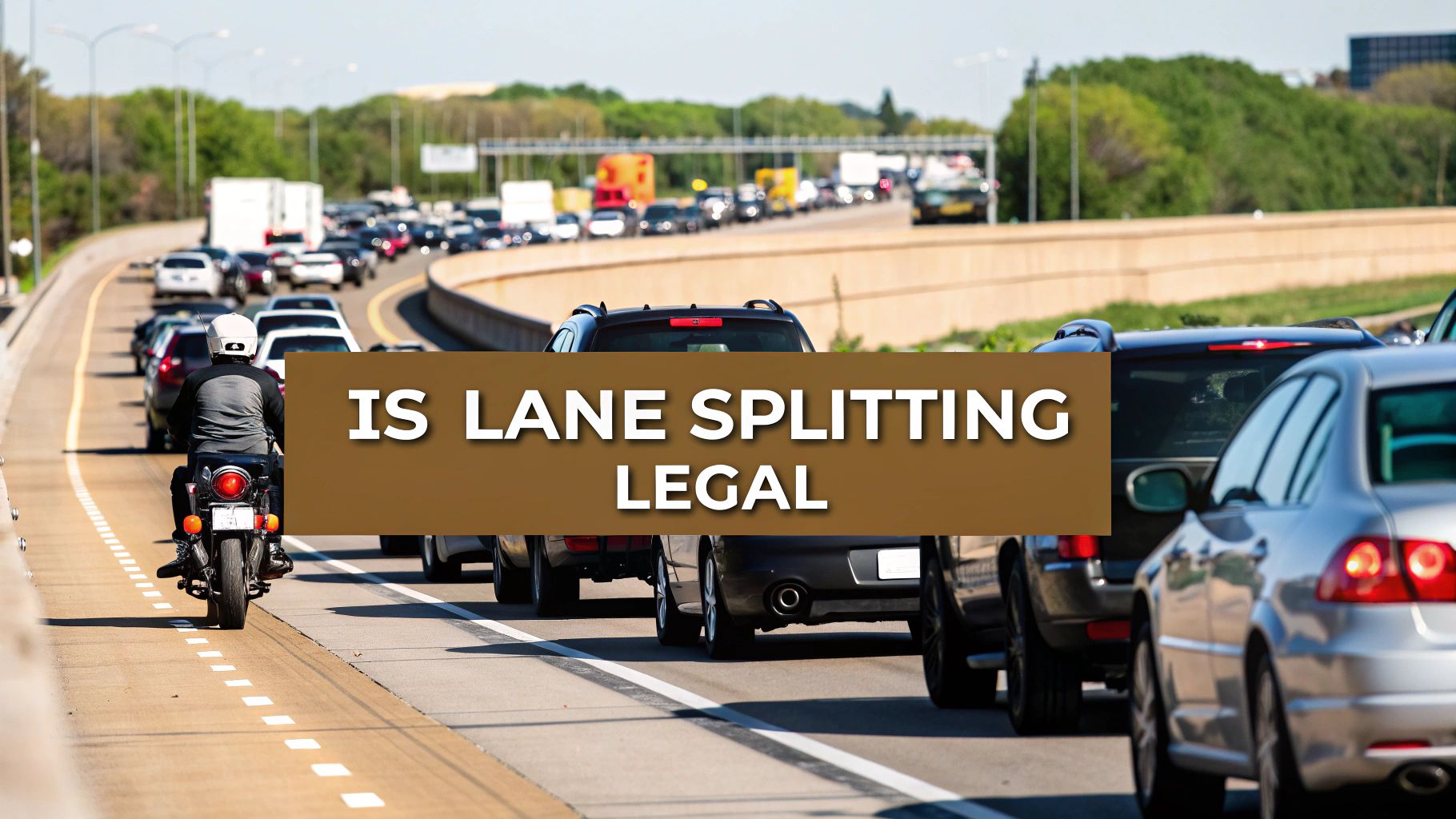
Riding on two wheels offers a kind of freedom you just can’t get in a car. But with that freedom comes a big question for riders nationwide: is lane splitting legal? The answer is surprisingly complex and changes drastically the moment you cross a state line. Right now, California is the only state whose vehicle code defines lane splitting.
Your Quick Guide to Lane Splitting Laws by State
For any motorcyclist stuck in gridlock, that sliver of space between lanes of stopped or slow-moving traffic looks mighty tempting. Riding through it is called lane splitting, which is formally defined as riding a motorcycle between rows of vehicles moving in the same direction. It’s a way to cut through congestion, save time, and, some argue, even avoid getting rear-ended.
But the legality of this move is one of the most tangled topics in traffic law. While it’s a daily sight on California freeways, trying it just about anywhere else can land you a ticket. A few other states, like Arizona and Utah, have dipped their toes in the water with a limited version called lane filtering. This usually just allows riders to move between stopped cars, like at a red light, not while traffic is flowing.
To make sense of this legal patchwork, here’s a quick overview of where things stand across the United States.
Most states have outlawed the practice entirely, while a few others have not passed any specific laws, leaving riders in a legal gray area.
U.S. Lane Splitting and Filtering Laws at a Glance
For a more detailed breakdown, this table offers a quick reference guide to the current laws across the country.
| Legal Status | States | Key Details |
|---|---|---|
| Defined in statute | California | Lane splitting is defined in Vehicle Code § 21658.1. The California Highway Patrol (CHP) has published educational safety tips for riders. |
| Legal (Filtering Only) | Arizona, Montana, Utah | Limited lane filtering is permitted under specific conditions, such as low speeds. |
| Illegal | Most States | Explicitly prohibited by traffic laws. Riders can be ticketed for “improper lane change” or similar violations. |
| No Specific Law | Arkansas, Texas, Oklahoma, etc. | No statute directly addresses lane splitting, creating a legal gray area. It’s often treated as illegal. |
Knowing these rules is about more than just avoiding a ticket. It is about your safety and your rights if an accident happens. The legality of what you were doing on the road may be a factor in any personal injury claim. California riders may also find the CHP’s educational safety tips helpful.
Understanding California’s Lane Splitting Law
Disclaimer: This article is for informational purposes only and is not to be construed as legal advice. No attorney-client relationship exists based on the review of this article, and none of the information provided constitutes legal advice.
Ask a rider if lane splitting is legal, and you’ll get a different answer depending on where you are in the country. It’s a complicated patchwork of rules, but here in California, the answer is a clear and simple “yes.”
California is the only state whose vehicle code defines the practice. This took lane splitting out of a legal gray area.
Assembly Bill 51 was signed in 2016 and took effect on January 1, 2017. Before then, riders did it, and law enforcement mostly looked the other way, but there was no statutory definition. AB 51 added Section 21658.1 to the California Vehicle Code, which defines lane splitting.
The law also authorizes the California Highway Patrol (CHP) to develop educational guidelines for safer lane splitting. The CHP’s current safety tips were published in 2018.
CHP Safety Tips for Lane Splitting
The CHP’s tips are educational. They are not laws with specific fines attached, and they do not decide fault on their own.
Courts may consider safe-riding practices when deciding fault; speak with a licensed attorney about your situation.
The CHP’s tips include:
- Consider the Total Environment: This is the big one. It means you have to constantly be scanning everything, traffic speed, how wide the lanes are, weather conditions, and the amount of space you have. Safe lane splitting is all about the situation you’re in.
- Manage Your Speed Differential: Danger increases as the speed difference between your motorcycle and the traffic around you grows.
- Avoid Splitting at High Speeds: Danger also increases at higher overall traffic speeds. The CHP does not publish a numeric cut-off.
Riding at a high speed differential, or in fast-moving traffic, may be viewed as unsafe if a crash occurs.
Lane splitting is meant for slow or stopped traffic, not for weaving through cars on the open freeway.
Putting the Safety Rules into Practice
Beyond speed, the CHP’s tips address specific situations. Paying attention to these details can help riders ride more safely.
The CHP’s tips say it is typically safer to split between the far-left lanes (the #1 and #2 lanes). Drivers in those lanes generally expect to be passed on the left. Splitting near on-ramps and exits, where cars are merging, can be more dangerous.
There are also times when you should just avoid splitting altogether:
- Bad Weather: Rain, fog, or slick roads are a hard no. Your visibility is lower, your tires have less grip, and it’s just not worth the risk.
- Wide Vehicles: Never try to squeeze past big rigs, buses, or trucks with wide trailers. Their blind spots are huge, and they might not see you at all.
- When in Doubt, Don’t: If you feel unsafe for any reason, maybe drivers are being erratic or the lanes seem too narrow, the smartest move is always to merge back into a lane and wait it out.
Ultimately, lane splitting is defined in California law, but that comes with personal responsibility. Part of that responsibility is wearing the right gear; you can learn more by reading our guide on motorcycle helmet laws in California. Following the CHP’s safety tips can help you ride more safely. Courts decide fault based on all the facts.
What Research Says About Lane Splitting and Safety
Disclaimer: This article is for informational purposes only and is not to be construed as legal advice. No attorney-client relationship exists based on the review of this article, and none of the information provided constitutes legal advice.
To anyone in a car, watching a motorcycle move between lanes can look like a daredevil stunt. One concern riders raise is rear-end collisions in stop-and-go traffic. One California study looked at what collision data shows.
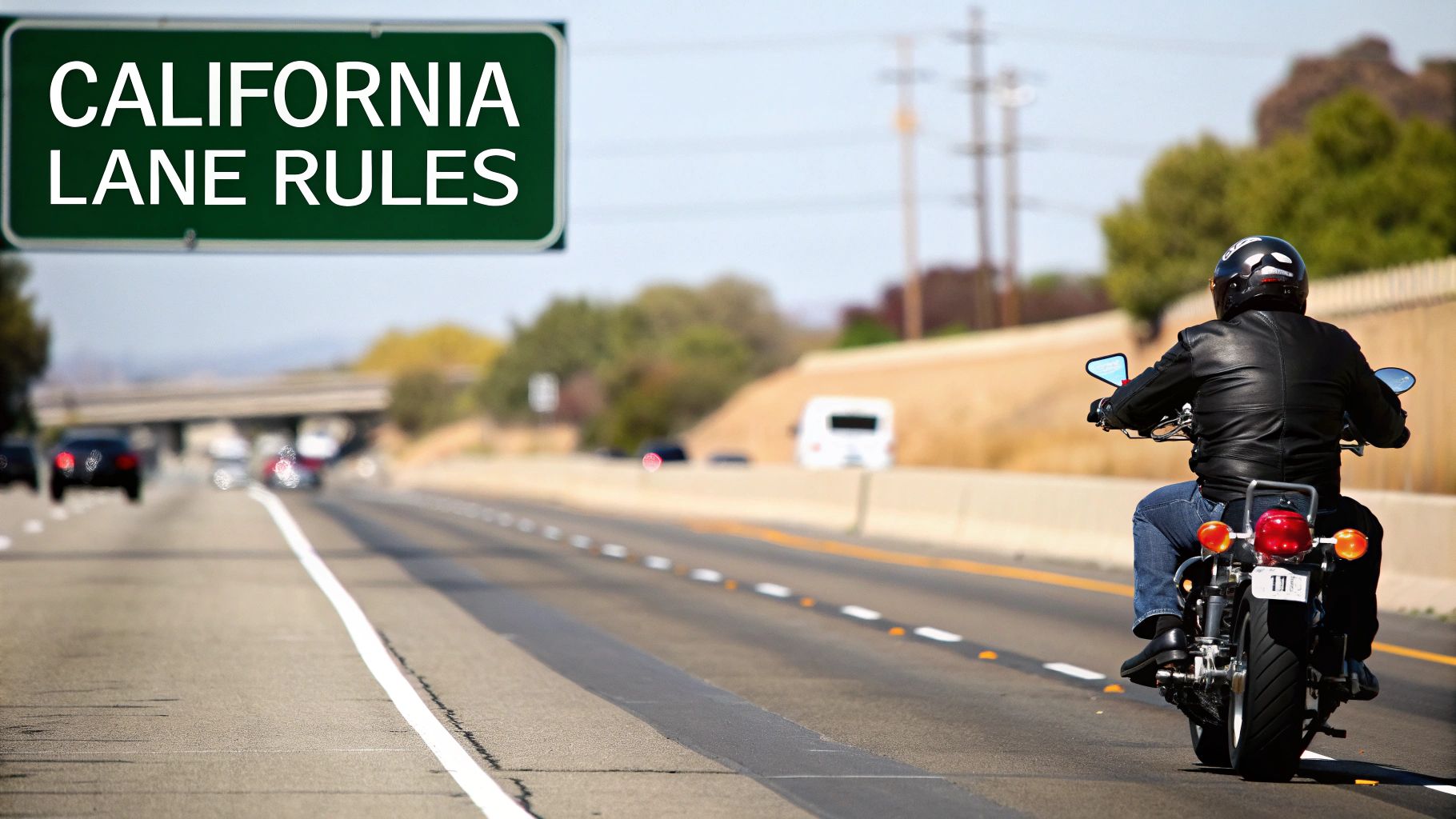
One concern riders raise is rear-end collisions. A motorcycle stopped in traffic has little protection if a distracted driver does not stop in time.
The Physics of Rider Safety
Picture this: a rider is stuck in bumper-to-bumper traffic. The driver behind them does not stop in time. A rear-end collision can cause serious injuries to a motorcyclist.
Data Backs Up the Safety Claims
A 2015 study from the UC Berkeley Safe Transportation Research and Education Center (SafeTREC) by Rice, Troszak and Erhardt looked at 5,969 motorcyclists involved in collisions in California from June 2012 to August 2013. Among motorcyclists in collisions, those who were lane splitting were less likely to suffer head injuries, torso injuries or fatal injuries than those who were not.
In the study, 2.6% of lane-splitting motorcyclists were rear-ended, compared with 4.6% of other motorcyclists in collisions. The study reported that lane splitting appeared relatively safe in traffic moving at 50 mph or less when the motorcyclist was no more than 15 mph faster than other vehicles. The study was observational and does not show that lane splitting causes fewer injuries. Read the full report from the California Office of Traffic Safety: Motorcycle Lane-splitting and Safety in California (2015).
Lane Splitting as a Defensive Technique
Ultimately, responsible lane splitting is just another tool in a defensive rider’s toolkit. It demands a high level of awareness, fine-tuned control, and sticking to safety guidelines, like keeping the speed difference low. Riders who split lanes properly are often more tuned in to their surroundings, constantly scanning for hazards instead of just passively waiting for traffic to move.
Think about how proper lane splitting incorporates key defensive riding principles:
- Increased Visibility: A bike moving slowly between lanes is often more noticeable than one tucked away in a car’s blind spot.
- Proactive Positioning: The rider is actively managing their space and maintaining an escape path, not just trapped in one spot.
- Hazard Anticipation: To split lanes safely, a rider has to constantly predict what drivers will do next, like an unexpected lane change, which makes them a more alert rider overall.
While the question “is lane splitting legal” still has different answers across the country, whether lane splitting is safe depends on speed, traffic conditions and rider behavior.
How the Rest of the World Handles Lane Splitting
Disclaimer: This article is for informational purposes only and is not to be construed as legal advice. No attorney-client relationship exists based on the review of this article, and none of the information provided constitutes legal advice.
Here in the United States, just mentioning “lane splitting” can kick off a heated debate. But for most of the world, it’s not a question at all, it’s just how you get through the daily commute. The controversy we have here stands in stark contrast to its widespread acceptance across Europe and Asia, where it’s seen as a common-sense solution to traffic jams.

Looking at it from a global perspective really changes the conversation. What might seem reckless to an American driver is an accepted way to manage traffic in packed cities from Amsterdam to Taipei. In these places, lane splitting isn’t merely tolerated; it’s an expected part of driving that both riders and car drivers know how to navigate.
A Look at European Norms
In Europe, the approach to lane splitting is far more unified and permissive. It is common in many EU countries, where it’s either explicitly legal or just an accepted, standard riding technique. To get a broader view, you can explore the global variations of lane splitting laws and see how different countries handle the practice.
For example, in the Netherlands, lane splitting is not only legal but actually encouraged in certain conditions to help ease traffic flow. Dutch riders are taught to filter through stopped or slow traffic as a matter of course. Other nations have their own slight variations:
- Germany: Generally permits filtering, but only when traffic is at a complete standstill.
- Spain: Technically, the practice is banned, but it’s often tolerated by police in congested city centers.
- Poland: The law is ambiguous, neither banning nor endorsing it, so it’s left up to the rider’s discretion.
Rules and practices vary widely from country to country.
Lessons from International Practice
Practice overseas offers some lessons. In countries where it’s common, there’s a shared understanding between drivers and riders.
Determining Fault in a Lane Splitting Accident
Disclaimer: This article is for informational purposes only and is not to be construed as legal advice. No attorney-client relationship exists based on the review of this article, and none of the information provided constitutes legal advice.
After any crash, the first question is always the same: Who’s at fault? This question gets a lot more complicated when a lane-splitting motorcyclist is involved. The answer almost always boils down to a legal concept called negligence.
Simply put, negligence means someone failed to act with reasonable care, and that failure caused harm. For a car driver, that could be anything from changing lanes without signaling to texting behind the wheel. For a rider, it could mean weaving recklessly through traffic.
The Role of CHP Guidelines in Proving Negligence
In California, you cannot just point a finger and say, “He was lane splitting, so it’s his fault.” Because the practice is defined in the Vehicle Code, a rider is not automatically to blame.
Think of it this way: if a driver suddenly cuts you off while you were riding at a reasonable speed for the conditions, the driver’s negligence may be clear. They had a duty to check their mirrors and blind spots.
But if you were moving between cars at high speed, a court may find you partly responsible, even if the driver also made a mistake.
Understanding Comparative Negligence
California follows a legal rule called “pure comparative negligence.” This is actually good news for riders. It means you can still recover money for your injuries even if you were partially to blame for the accident. Your final compensation is just reduced by whatever percentage of fault is assigned to you.
For a deeper look at this principle, check out our detailed guide on what is pure comparative negligence.
Here’s how it works in the real world:
- A driver makes an unsafe lane change, hitting a motorcyclist who is lane splitting.
- A court finds the driver was 80% at fault because they didn’t signal or check their mirrors.
- However, the court also determines the rider was going 15 mph faster than traffic, making them 20% at fault.
- If the total damages (medical bills, lost wages, bike repairs) add up to $100,000, the rider can recover $80,000 ($100,000 minus their 20% share of fault).
This system is why speed and riding conduct can matter in a claim. Fault is decided on all the facts.
How Insurers May Evaluate Fault
Insurers evaluate claims using their own criteria. They may argue that lane splitting is inherently dangerous, regardless of its legality.
An attorney can explain how fault may be assigned and which evidence may be relevant. It is worth asking how fees and case costs work and getting the terms in writing.
Your Action Plan After a Lane Splitting Crash
Disclaimer: This article is for informational purposes only and is not to be construed as legal advice. No attorney-client relationship exists based on the review of this article, and none of the information provided constitutes legal advice.
The moments right after a crash are a blur of adrenaline and confusion. What you do next can matter for your health and your claim.
Knowing the right steps is important after any crash. Following a plan can help protect your rights and your recovery.
Your absolute first priority is safety. If you’re able, move yourself and your bike out of traffic to avoid a second collision. Next, get medical attention immediately. Adrenaline is a powerful painkiller and can easily hide serious injuries that will show up hours or days later.
Document Everything at the Scene
Once you are safe, it is time to start collecting evidence. Details gathered right after the crash can be useful later. A fuzzy memory of what happened is harder to rely on than photos and notes.
Here’s what you need to start documenting with your phone:
- Photos and Videos: Take pictures of everything. Get wide shots of the entire scene, close-ups of the damage to all vehicles from every angle, the final resting spots of the cars and your bike, skid marks, and any relevant traffic signs or signals.
- Contact Info: Swap insurance and contact details with the other driver. Just as importantly, get the names and phone numbers of anyone who saw what happened. Eyewitness accounts can be helpful.
- Police Report: Always call the police to get an official report filed. When the officer shows up, calmly and clearly state the facts. Stick to what you know for sure, and don’t guess or speculate about speed or fault.
Protect Your Legal and Financial Interests
After you’ve left the scene and seen a doctor, the next phase is all about protecting your legal rights and starting down the path to financial recovery.
- Notify Your Insurance: Report the accident to your own insurance company as soon as you can, but only give them the basic facts. Do not agree to a recorded statement or sign anything from the other driver’s insurance company until you’ve spoken with an attorney.
- Preserve the Evidence: Don’t throw away your damaged riding gear. Also, keep a detailed file of all your medical treatments, bills, and related expenses.
- Understand the Process: After a lane splitting accident, knowing which categories of damages may apply is part of your action plan.
Navigating the aftermath of any accident is complicated, and there are many small but critical steps to take. For a more general rundown, our guide on what to do after a car accident can be a helpful resource. Following a clear plan from the start can help you avoid missing steps that could affect your claim.
How an Attorney May Help With Your Claim
Disclaimer: This article is for informational purposes only and is not to be construed as legal advice. No attorney-client relationship exists based on the review of this article, and none of the information provided constitutes legal advice.
After a lane-splitting accident, you may be dealing with injuries and an insurance claim at the same time. An attorney can explain your options.
Evidence can disappear quickly. Dashcam footage from other cars may be overwritten, and traffic camera recordings may be deleted after a short period. An attorney can explain how evidence may be requested or preserved.
An attorney can review the facts under California’s Vehicle Code and explain how fault may be argued. Insurers may raise the fact that you were lane splitting when they evaluate a claim.
Understanding Damages
Damages depend on the facts of your case. A licensed attorney can explain which categories may apply. A claim may account for more than your initial emergency room bill and the cost to fix your bike, now and in the future.
This includes things like:
- Future Medical Costs: What about the ongoing physical therapy, potential future surgeries, or long-term care you might need?
- Lost Income: It’s not just about the paychecks you’ve already missed. What if your injuries affect your ability to earn a living down the line? That’s your diminished earning capacity.
- Pain and Suffering: This is compensation for the physical pain, the emotional trauma, and the simple loss of being able to enjoy your life the way you used to.
Navigating Complex Legal Scenarios
An attorney can also explain legal issues that may follow a crash, such as a hit and run. Ask how communication with insurers is handled.
Disclaimer: This article is for informational purposes only and is not to be construed as legal advice. No attorney-client relationship exists based on the review of this article, and none of the information provided constitutes legal advice.
Attorney Advertising. This article is general information, not legal advice, and does not create an attorney-client relationship. Prior results do not guarantee a similar outcome.