
Your Guide to California's Lane Splitting Laws
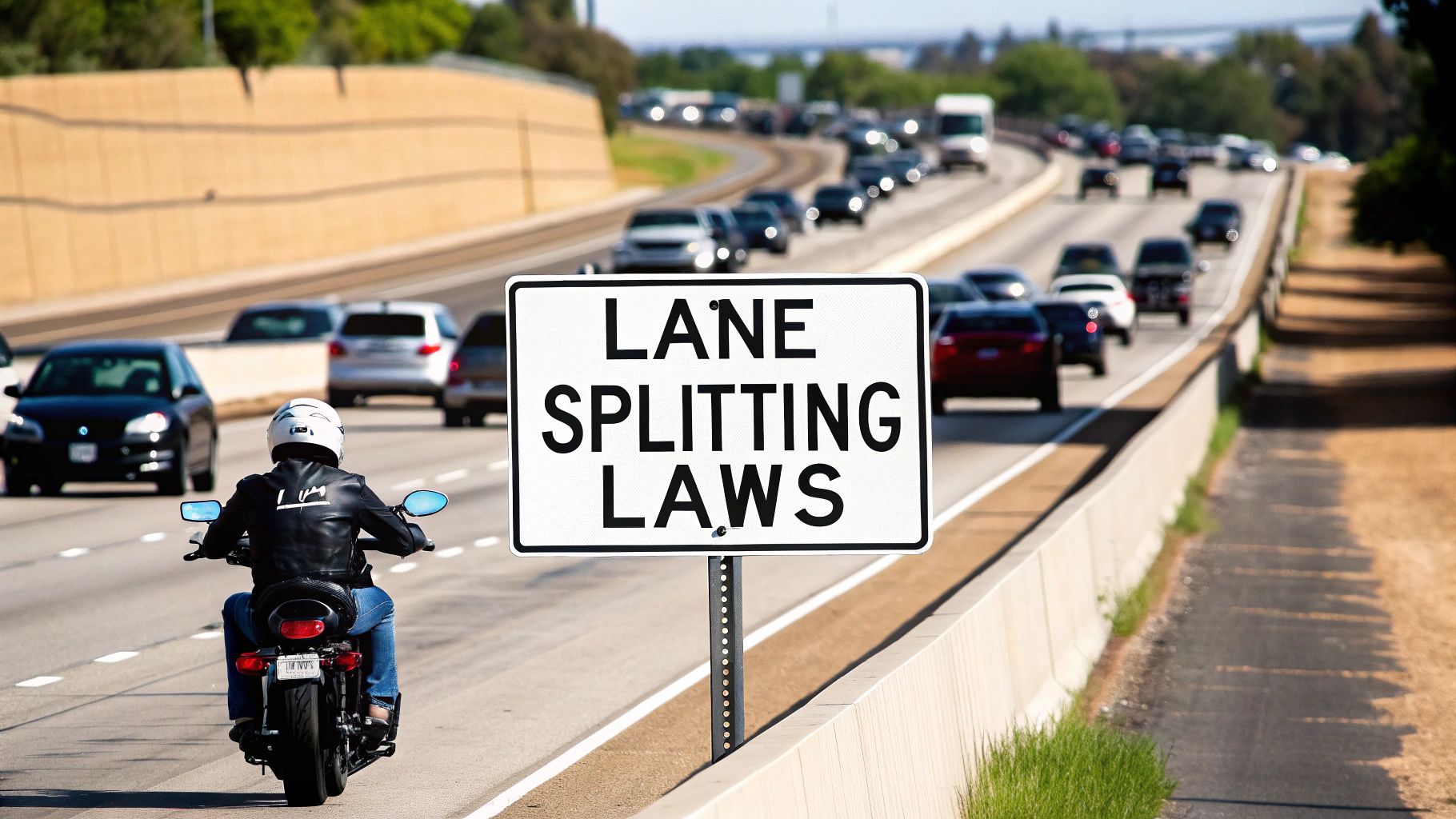
If you’re a rider in California, you already know the state stands apart. It’s the only place in the country where lane splitting is officially legal, giving motorcyclists a unique advantage in our notoriously congested traffic. But what does that really mean for you on the road?
This guide is designed to break it all down. Just remember, this article is for informational purposes and not to be construed as legal advice. No attorney client relationship exists based on the review of this this article and none of the information in this article is legal advice.
Your Essential Guide to Lane Splitting in California
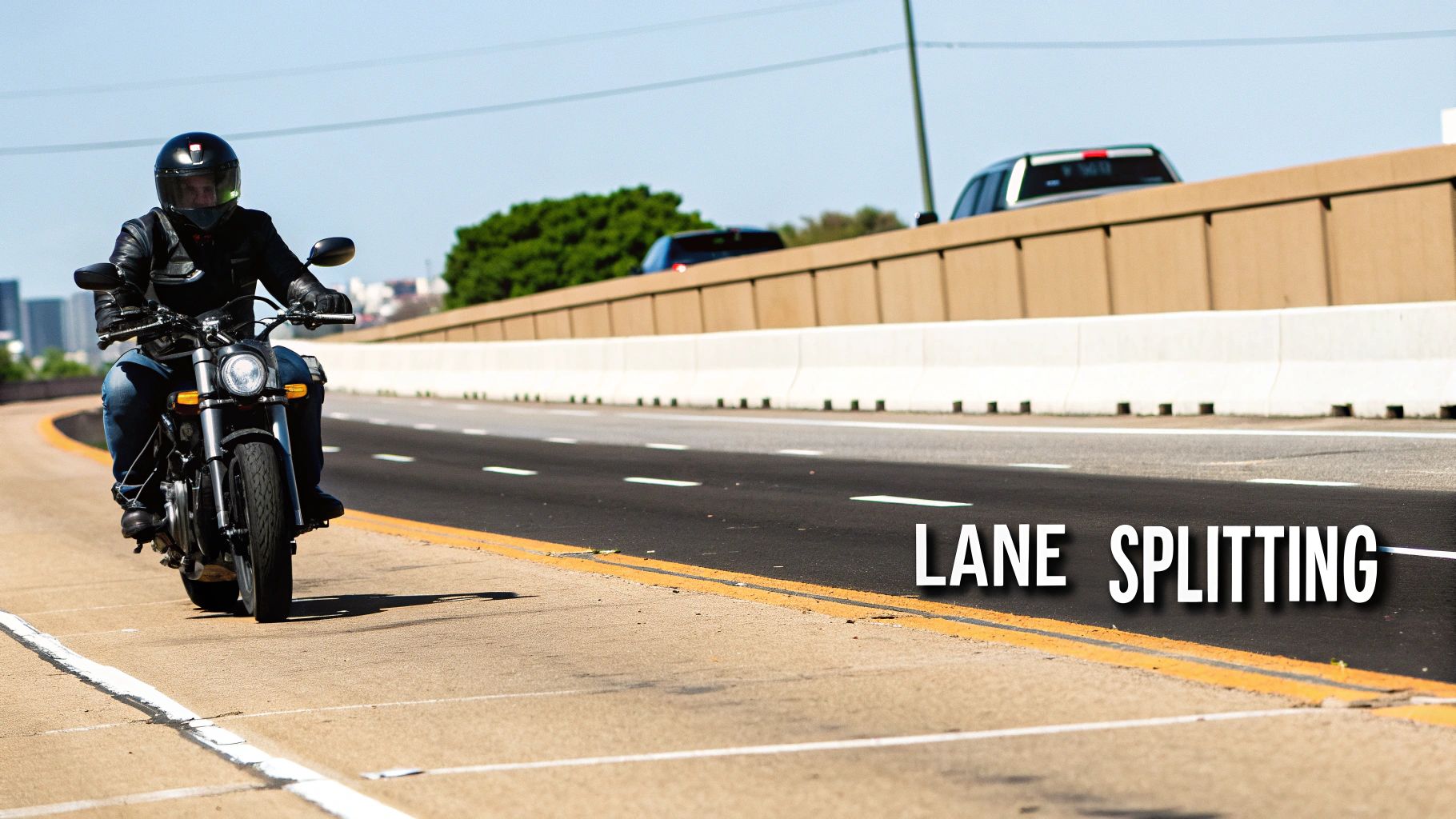
You’ve seen it a thousand times. Stuck in bumper-to-bumper traffic on a Southern California freeway, you watch a motorcyclist glide right past, moving between the lanes. This move, known as lane splitting, is a daily sight in the Golden State, but it’s still a source of confusion and questions for riders and drivers alike.
Lane splitting, also called white-lining or filtering, is the act of a motorcycle riding between lanes of slow-moving or stopped traffic. Instead of being stuck in a single lane with cars and trucks, riders can use that gap to navigate congestion more efficiently. It is a practice that makes California’s traffic laws unique.
A Landmark Law for Motorcyclists
California is the only state whose vehicle code defines lane splitting. Section 21658.1 of the California Vehicle Code took effect on January 1, 2017.
Before 2017, the Vehicle Code did not define lane splitting. Section 21658.1 now defines it and authorizes the California Highway Patrol (CHP) to develop educational guidelines. Understanding this law is a useful first step for any rider in the state.
The Unwritten Rules: Core Principles of Safe Lane Splitting
The Vehicle Code does not set fixed numeric speed limits for lane splitting. The CHP has published educational safety tips, which are summarized below.
Here is a quick-reference table summarizing the CHP’s safety tips for riders who filter through traffic.
Core Principles of Safe Lane Splitting
| Aspect | CHP Safety Tip |
|---|---|
| Speed Differential | Danger increases as the speed difference between your motorcycle and surrounding traffic grows. |
| Overall Speed | Danger also increases at higher overall traffic speeds. The CHP does not publish a numeric cut-off. |
| Lane Choice | It is typically safer to split between the far left lanes. |
| Situational Awareness | Always account for lane width, the size of nearby vehicles, and current road conditions. |
These tips can help riders think through how to ride responsibly. For California’s electric scooter rules, check current DMV and local guidance.
Next, we’ll dig deeper into the specific California Highway Patrol (CHP) guidelines, see how our state’s approach compares to others, and discuss what happens when a lane-splitting accident occurs.
Understanding the Law and CHP Safety Guidelines
We have established that lane splitting is defined in California law, but knowing the specifics can help you ride more safely and understand your rights after a crash. The law itself is fairly short. The California Highway Patrol (CHP) has published educational safety tips for riders and other drivers.
Think of it this way: the law gives you permission, but the CHP guidelines show you how to use that permission responsibly.
The legal definition comes from California Vehicle Code § 21658.1. This law defines lane splitting as riding a motorcycle between rows of stopped or moving cars in the same lane. The law does not set hard speed limits or specific restrictions. Instead, it authorizes the CHP to develop educational safety guidelines for riders and other drivers.
The CHP’s tips are educational and are not law. Courts may consider safe-riding practices when deciding fault; speak with a licensed attorney about your situation.
Disclaimer: This article is for informational purposes and not to be construed as legal advice. No attorney client relationship exists based on the review of this this article and none of the information in this article is legal advice.
Translating CHP Guidelines into Action
The CHP’s safety tips focus on reducing risk by making a motorcycle’s movements predictable for everyone on the road. They are educational and are not a legal rulebook.
The CHP’s tips note that danger increases at higher overall speeds and at higher speed differentials between a motorcycle and the cars around it.
Safety messages in the CHP’s tips include:
- Speed Differential: Danger increases as the speed difference between you and the surrounding traffic grows. A smaller gap gives you and other drivers more time to react to anything unexpected.
- Overall Speed: Danger also increases at higher overall traffic speeds. The CHP does not set a numeric cut-off, so use caution and good judgment.
- Choose Your Lane Wisely: It is typically safer to split between the far left lanes (often called the #1 and #2 lanes). Drivers in those lanes are more accustomed to faster-moving traffic passing them on the left.
- Stay Out of Blind Spots: Don’t hang out where a driver can’t see you. A simple rule of thumb: if you can’t see the driver’s face in their side mirror, they can’t see you.
Situational Awareness: The Rider’s Responsibility
Beyond speed and lane choice, the CHP stresses situational awareness. This means you are constantly scanning and assessing the environment before and during any lane-splitting maneuver. It is not about what you are allowed to do, but what is safe to do in that exact moment.
Before you even think about splitting, ask yourself:
- Lane Width: Are the lanes wide enough for your bike with a safe buffer on each side?
- Vehicle Size: Be extra careful around big rigs, buses, and RVs. Their blind spots are massive, and they might not see you at all.
- Road Conditions: Is the pavement wet? Are there potholes or debris? Bad conditions can make a tricky maneuver downright dangerous.
- Visibility: Make yourself seen. Wear bright or reflective gear to stand out. Proper safety equipment is a must, and you can get the full rundown in our guide to California’s motorcycle helmet laws.
Ultimately, smart lane splitting is about finding the safest path through congestion. Knowing the law and the CHP’s safety tips can help you navigate California’s traffic with more confidence.
How Other States View Lane Splitting and Filtering
To understand how California’s approach compares, it helps to look at the rest of the country. Riders in California can legally split lanes, but most other states have a patchwork of rules that are more restrictive, if they allow it at all.
This contrast is huge. It doesn’t just highlight how unique things are for California motorcyclists; it underscores why you absolutely must know the local laws before riding into another state. A move that’s perfectly normal on a Los Angeles freeway could land you a hefty ticket just one state over.
The Key Difference: Lane Splitting vs. Lane Filtering
First, let’s clear up two terms that often get tossed around interchangeably but mean very different things under the law: lane splitting and lane filtering.
- Lane Splitting: This is the big one. It generally means riding your motorcycle between lanes of moving traffic. This is the practice California allows, guided by CHP safety principles.
- Lane Filtering: Think of this as the more cautious, limited version. It typically means riding between lanes of stopped or nearly stopped vehicles, like at a red light or in a total gridlock situation.
Most states that have even considered legalizing the practice have gone with the more conservative “lane filtering” model. They put tight restrictions on how fast you can go and the speed of surrounding traffic. This distinction is the bedrock of the more limited laws you see popping up elsewhere.
A Small but Growing Group of States
California is the only state that defines lane splitting. A few other states, including Utah, Arizona and Montana, allow a limited form called lane filtering, each with its own rules. Laws change, so check current rules before you ride in another state.
Montana, for example, allows riders to overtake vehicles that are stopped or creeping along at no more than 10 mph. The catch? The rider can’t go faster than 20 mph while doing it. If you want to dive deeper into the nationwide conversation, you can find detailed discussions on why advocates are pushing to make lane splitting legal in all 50 states.
Utah and Arizona allow filtering only between stopped vehicles, on roads with a posted speed limit of 45 mph or less. They do not allow splitting between moving cars at higher speeds.
Disclaimer: This article is for informational purposes and not to be construed as legal advice. No attorney client relationship exists based on the review of this this article and none of the information in this article is legal advice.
The Majority View Still Says No
Most states do not allow lane splitting or filtering. In most places, a motorcycle is legally treated like any other vehicle and has to stay within a single lane at all times.
Trying to split lanes in one of these states can get you cited for anything from an improper lane change to reckless driving.
California’s approach is different from other states. Rather than rigid speed limits in the statute, it relies on CHP educational safety tips. To learn more about how the law came about, you can read also about the legality of lane splitting.
The Data Behind Lane Splitting Safety
When we talk about lane splitting laws, one question comes up often: is it safe? To someone in a car, watching a motorcycle move between lanes of traffic can look risky. One California study looked at what the collision data shows.
A Look at the Numbers
The best-known California research is a 2015 study from the UC Berkeley Safe Transportation Research and Education Center (SafeTREC) by Rice, Troszak and Erhardt. It looked at 5,969 motorcyclists involved in collisions from June 2012 to August 2013, 997 of whom were lane splitting at the time. Among motorcyclists involved in collisions, those who were lane splitting were less likely to suffer severe or fatal injuries than those who were not.
Among the motorcyclists in the study, 2.6% of those who were lane splitting were rear-ended, compared with 4.6% of those who were not.
The study also reported lower rates of some injuries among lane-splitting motorcyclists who were in collisions:
- Head injuries: 9% of lane-splitting motorcyclists, compared with 17% of others.
- Torso injuries: 19% of lane-splitting motorcyclists, compared with 29% of others.
- Fatal injuries: 1.2% of lane-splitting motorcyclists, compared with 3.0% of others.
The study also reported that lane splitting appeared relatively safe when traffic was moving at 50 mph or less and the motorcyclist was no more than 15 mph faster than other vehicles. You can read the full report from the California Office of Traffic Safety: Motorcycle Lane-splitting and Safety in California (2015).
Key Takeaway: The study is observational. It describes patterns among motorcyclists who were in collisions and does not show that lane splitting causes fewer injuries.
The Other Side: Public Perception and Driver Anxiety
Even with the study’s findings, the biggest hurdle for lane splitting is still public perception. A lot of drivers simply do not know the practice is defined in California law, and many get nervous when they see a bike coming up between lanes in their rearview mirror. That anxiety usually comes from a fear of the unknown or the mistaken belief that the rider is being reckless.
This creates a tricky social dynamic on the road. A rider’s safety isn’t just about their own skill; it’s also about anticipating how a nervous or surprised driver might react.
Defensive riding in this context means understanding driver psychology:
- Anticipate Sudden Moves: A startled driver might jerk the wheel or change lanes without thinking to check their blind spot first.
- Be Predictable: Your movements should be smooth and deliberate. Avoid sudden bursts of speed or weaving, which can easily alarm other drivers.
- Make Eye Contact: Whenever you can, try to make eye contact with drivers. It’s a simple way to confirm they’ve seen you and know you’re there.
Ultimately, educating the public and bridging the gap between the statistics and public perception is an ongoing process. For riders, a sensible approach is to ride with extra caution and assume that other drivers might not see you.
Disclaimer: This article is for informational purposes and not to be construed as legal advice. No attorney client relationship exists based on the review of this this article and none of the information in this article is legal advice.
Determining Fault in a Lane Splitting Accident
When a lane splitting accident happens, the scene is often pure chaos. Figuring out who is legally at fault is almost never a clear-cut issue. Because the rider was moving between lanes of traffic, many people—including insurance adjusters and even the police officers who show up—might jump to the conclusion that the motorcyclist is automatically to blame.
But California law sees things differently. The state operates under a “comparative negligence” rule, which is a crucial concept for any rider to understand.
It means that even if you’re found partially responsible for the crash, you can still recover money for your injuries and bike repairs. Your final compensation is simply reduced by whatever percentage of fault is assigned to you. For example, if you’re deemed 20% at fault, you can still collect 80% of the total damages.
Disclaimer: This article is for informational purposes and not to be construed as legal advice. No attorney client relationship exists based on the review of this this article and none of the information in this article is legal advice.
The Role of CHP Guidelines in Proving Fault
California’s lane splitting law does not set specific speed limits, and the CHP’s safety tips are educational. They are not law, and they do not decide fault on their own.
Courts may consider safe-riding practices when deciding fault; speak with a licensed attorney about your situation.
Here’s how this plays out in the real world:
- A Car Changes Lanes Abruptly: A driver who drifts into your path without signaling or checking their blind spot may be assigned most of the fault.
- A Rider Moves Too Quickly: A rider who is moving through traffic at high speed, or at a large speed difference from the cars around them, may be assigned part of the fault, even if the car also made an unsafe lane change.
Gathering Evidence Is Your First Priority
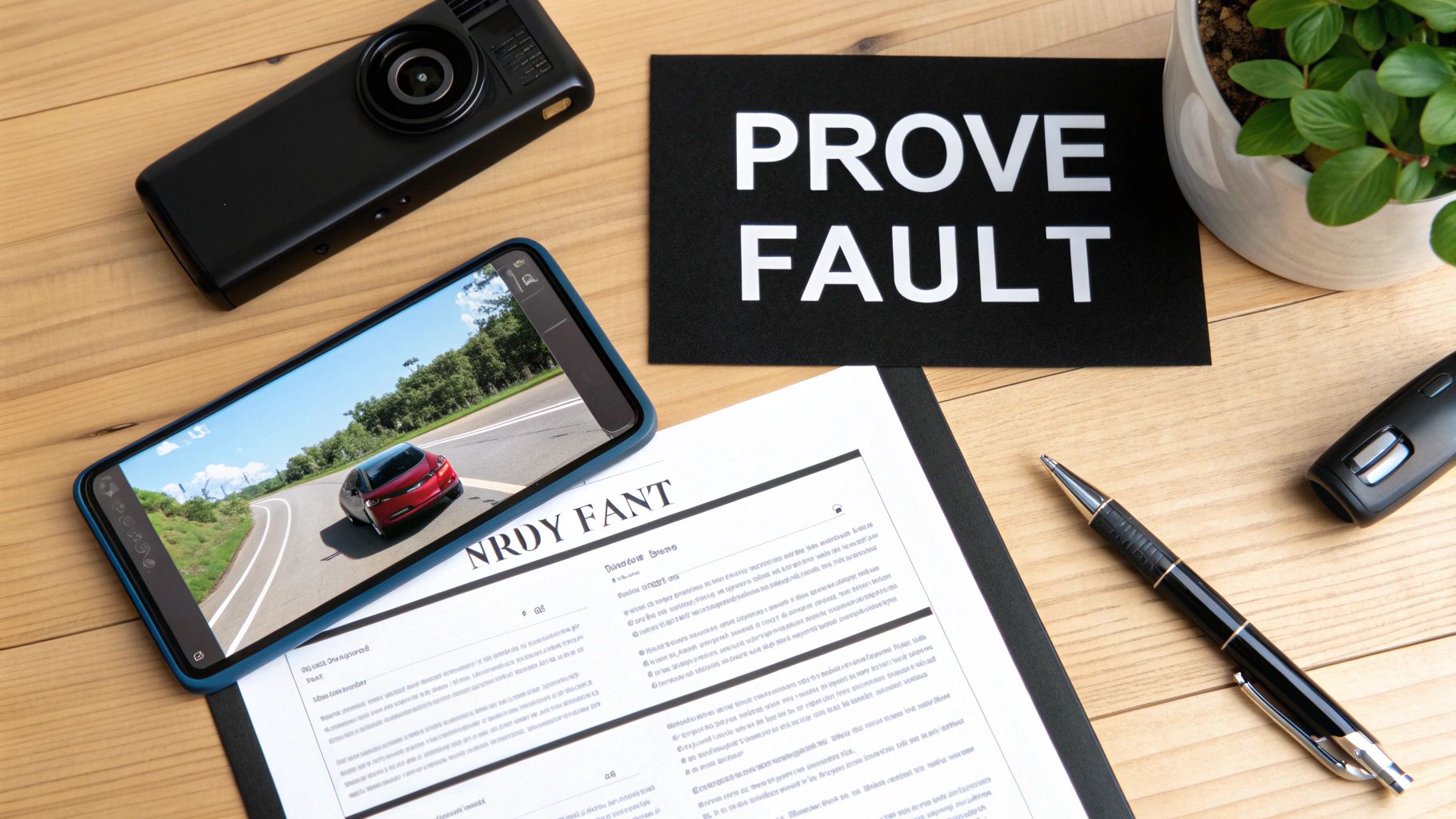
In any crash, but especially a lane splitting one, the evidence you collect at the scene can matter a great deal. Insurers evaluate claims using their own criteria, so clear evidence can help show what happened.
Here’s where you need to focus:
- Police Report: Always call 911 and make sure an official report is filed. Calmly tell the officer exactly what happened from your point of view. If the other driver said something like “I didn’t see you,” make sure the officer hears that.
- Witness Information: Independent witnesses are gold. Get the names and phone numbers of anyone who saw what happened.
- Photos and Videos: Use your phone to become a crime scene investigator. Take pictures of everything: where the vehicles ended up, the damage to your bike and their car, any skid marks on the road, the weather conditions, and nearby traffic signs.
How Your Actions Impact Your Claim
Your own behavior, both during the crash and in the minutes and days that follow, may be reviewed. Insurers evaluate claims using their own criteria.
To protect yourself and strengthen your claim, you have to be smart:
- Stick to the Facts: When you talk to the police or an insurance company, only state what you know for sure. Don’t guess, don’t apologize, and don’t admit any fault. A simple statement like “The car merged into my lane” is far better than “I guess I was in their blind spot.”
- Seek Medical Attention: Get checked out by a doctor soon after the crash, even if you think you are okay. Adrenaline can mask serious injuries. Delays in treatment may be raised later when a claim is evaluated.
In the end, successfully navigating a lane splitting claim comes down to understanding the rules of comparative negligence and backing up your story with hard evidence.
How a Motorcycle Accident Attorney Can Help You
If you have been hurt in a lane splitting accident, the aftermath can be stressful. You are trying to heal from your injuries, but the medical bills may already be piling up.
Handling an insurance claim on your own can be difficult. Early settlement offers may not reflect your future medical needs.
Protecting Your Rights and Seeking Compensation
An attorney can explain your options and, if you hire one, may communicate with the insurance companies on your behalf. Ask how communication with insurers is handled.
Depending on the case, an attorney may also gather information about the crash.
This may include:
- Gathering Evidence: Obtaining the police report, identifying witnesses, and locating dashcam or security camera footage.
- Consulting Experts: In more complicated cases, an attorney may involve accident reconstruction or medical experts.
- Documenting Damages: Collecting medical records and other documents that show your damages.
Disclaimer: This article is for informational purposes and not to be construed as legal advice. No attorney client relationship exists based on the review of this this article and none of the information in this article is legal advice.
Calculating the True Cost of Your Accident
One role an attorney may play is explaining which categories of damages may apply to your claim. Damages depend on the facts of your case. A claim can include both economic (out-of-pocket) and non-economic (personal) losses.
Categories of damages may include:
- All Medical Expenses: This isn’t just the emergency room visit. It includes surgeries, physical therapy, prescription drugs, and any future care you might need down the road.
- Lost Income: They’ll calculate not just the paychecks you’ve already missed, but also any impact the injury will have on your ability to earn a living in the future.
- Pain and Suffering: This is compensation for the physical pain, emotional trauma, and the loss of quality of life you’ve experienced because of someone else’s mistake.
- Property Damage: This covers the cost to get your bike repaired or replaced, along with any damaged riding gear.
To learn more about this role, see our guide on why you may need a motorcycle accident attorney after a crash.
Your Lane Splitting Questions, Answered
Riding in California comes with its own set of rules, and lane splitting is one of the most unique. It’s a topic that brings up a lot of questions for riders. To clear things up, we’ve put together answers to some of the most common things people ask about lane splitting.
Think of this as your quick-reference guide to reinforce the key takeaways from this article.
Is Lane Splitting Actually Legal in California?
California is the only state whose vehicle code defines lane splitting. California Vehicle Code § 21658.1 gives the practice its formal definition. The law took effect on January 1, 2017.
What Is the Speed Limit for Lane Splitting?
There is no specific speed limit for lane splitting written into the law. Instead, the California Highway Patrol (CHP) has published educational safety tips that every rider should know. They are not law. Tips include:
- Speed Differential: Danger increases as the speed difference between you and the cars around you grows.
- Overall Speed: Danger also increases at higher overall traffic speeds.
Following safe-riding practices may help show that you were riding with care, but fault is decided on all the facts.
Disclaimer: This article is for informational purposes and not to be construed as legal advice. No attorney client relationship exists based on the review of this this article and none of the information in this article is legal advice.
What Happens If a Car Hits Me While I’m Lane Splitting?
This is where things can get complicated. California uses a “comparative negligence” system, which means that fault for an accident can be shared. If a car hits you while you’re splitting lanes, who is held liable depends on what both of you were doing right before the crash.
For instance, if a driver makes a sudden lane change without looking and hits you, they’ll likely carry the lion’s share of the blame. But, if you were splitting lanes way too fast for the conditions, you could be found partially at fault. This could reduce the amount of compensation you can recover.
Can I Get a Ticket for Lane Splitting Improperly?
While you won’t get a ticket that says “lane splitting,” you can definitely be cited for other violations if you do it in a reckless manner. An officer could write you up for speeding, making an unsafe lane change, or even reckless driving if your lane splitting puts others in danger.
Is It Safer to Split Between Certain Lanes?
Yes. The CHP’s safety tips say it is typically safer to split between the two lanes on the far left (the #1 and #2 lanes). Drivers in the “fast lanes” are usually more alert to vehicles passing them and are more likely to anticipate a motorcycle coming through.
But remember, no two situations are the same. You always have to be the judge. Look at how wide the lanes are, what kinds of vehicles are around you, and the road conditions before you make your move.
If a lane splitting accident has left you injured, an attorney can explain your options. Contact LA Law Group, APLC for a consultation. It is worth asking how fees and case costs work and getting the terms in writing. Find out more at https://www.bizlawpro.com.
Attorney Advertising. This article is general information, not legal advice, and does not create an attorney-client relationship. Prior results do not guarantee a similar outcome.