
Motorcycle Accident Attorney San Jose motorcycle accident attorney san jose tips

Being in a motorcycle accident is one of the most chaotic and disorienting things you can experience. If you’re here, looking for a motorcycle accident attorney in San Jose, you’re already taking the right first step toward protecting your rights and getting the resources you need to heal.
Disclaimer: This article is for informational purposes and is not to be construed as legal advice. No attorney-client relationship exists based on the review of this article, and none of the information in this article is legal advice.
Your Guide to Immediate Actions After a San Jose Crash
Riders face unique dangers on San Jose roads, and the lack of protection compared to a car means injuries are often severe.
Period. You might feel okay at first, but adrenaline is a powerful painkiller. It can easily mask serious injuries like internal bleeding or a concussion that won’t show symptoms for hours, or even days.
Protecting Your Health and Your Rights
Having a clear plan of action can bring a little order to a very stressful situation and build a strong foundation for your injury claim. Think of each step as serving two crucial purposes: protecting your well-being and preserving vital evidence.
Here are the key things to do:
- Get to Safety: If you can, move yourself to a safe spot away from traffic to avoid another collision. Try not to remove your helmet or other gear unless you absolutely have to for breathing, it could make a potential neck or spine injury much worse.
- Call 911 Immediately: Always call for help. Paramedics can provide emergency care on the spot, and that initial medical evaluation is essential for documenting your injuries from the very beginning.
- Document Everything: If you’re able, pull out your phone. Take photos and videos of everything you can see: the accident scene, your injuries, the damage to the other vehicle, and any important details on the road like skid marks or debris.
This visual guide breaks down the core process to follow right after a crash. It keeps things simple so you can focus on securing your safety and preparing for what comes next.
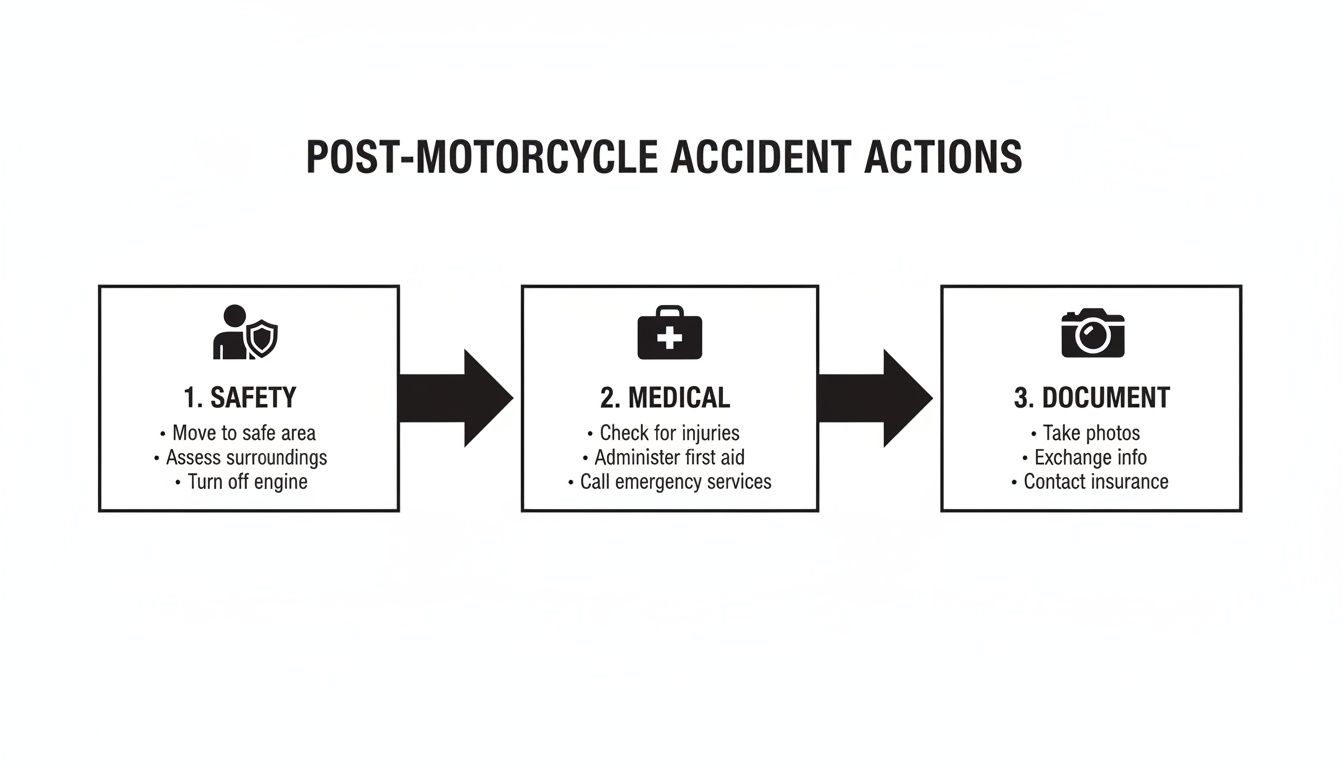
As you can see, the flow is straightforward: your safety comes first, followed by a medical check-up and then gathering evidence.
Immediate Post-Accident Checklist for San Jose Riders
To make it even clearer, here is a simple checklist. Following these steps right after a crash in San Jose is the best way to protect your health and your legal options down the road.
| Action Step | Why It’s Critical for Your San Jose Claim |
|---|---|
| Call 911 | Creates an official police report and brings immediate medical help. This report is a cornerstone of any injury claim. |
| Get Medical Attention | Documents your injuries from the moment of impact, proving they were caused by the crash. Adrenaline can mask serious harm. |
| Take Photos & Videos | Visual evidence is powerful. Capture vehicle positions, damage, injuries, road conditions, and any traffic signs. |
| Exchange Information | Get the other driver’s name, license, insurance, and contact info. Do not admit fault or apologize. |
| Don’t Talk to Insurers | Politely decline to give a recorded statement to the other party’s insurance company until you’ve spoken with a lawyer. |
The initial steps taken at the scene of a motorcycle accident in San Jose can matter for your claim.
Navigating California’s legal system after an injury can feel overwhelming, especially when you’re trying to recover. For a deeper look into the specifics, you can learn more about what to do after being injured in a motorcycle accident in California in our detailed guide.
A lawyer can help make sure your story is heard and work to hold the negligent parties accountable.
Disclaimer: This article is for informational purposes and is not to be construed as legal advice. No attorney-client relationship exists based on the review of this article, and none of the information in this article is legal advice.
After a motorcycle crash, ask any lawyer you consider how often they handle motorcycle claims.
A motorcycle accident attorney in San Jose can focus on the issues these claims raise.
Insurance adjusters, and even potential jurors, often leap to the conclusion that the rider was the one being reckless, speeding, weaving through traffic, or otherwise causing the accident.
They build a case from day one, prepared to prove the other party’s fault and present your side of the story.
Local Knowledge and Professional Networks
Winning a case in San Jose isn’t just about knowing California law; it’s about having an intimate understanding of the local roads, courts, and community.
A San Jose motorcycle attorney with deep roots in the community brings several key advantages:
- Local Traffic Knowledge: They get the specific dangers of intersections on Monterey Road or the high-speed chaos on I-280 and I-880. This allows them to paint a vivid, accurate picture of exactly how the accident happened.
- Courtroom Familiarity: They know the judges and opposing counsel in Santa Clara County. This isn’t just trivia; it’s a strategic edge during negotiations and, if it comes to it, at trial.
Local insight and professional connections can help build a case.
Understanding the Unique Risks Riders Face
Motorcyclists face a much higher risk of dying in a crash than people in passenger cars.
Disclaimer: This article is for informational purposes and is not to be construed as legal advice. No attorney-client relationship exists based on the review of this article, and none of the information in this article is legal advice.
Understanding California Motorcycle Laws and Your Rights
To win a motorcycle accident claim, you have to know the rules of the road, and the rules of the courtroom. California’s laws aren’t just suggestions; they’re the entire framework that determines who was at fault and how much compensation you can get. A good motorcycle accident attorney in San Jose uses this framework to build your case from the ground up and protect you every step of the way.
One of the first, and most important, concepts you’ll come across is comparative negligence. California uses a “pure comparative negligence” rule, and it’s a make-or-break factor in nearly every accident case.
How Comparative Negligence Affects Your Claim
Think of blame like a pie chart. The law gets that accidents are rarely 100% one person’s fault. Under this rule, you can still get compensation even if you share some of the responsibility for the crash.
Let’s play it out. Say a car pulls an illegal left turn right in front of you, and you collide. But maybe you were going five miles per hour over the speed limit. A court could look at that and decide the other driver was 90% at fault for the illegal turn, but you were 10% at fault for speeding.
If your total damages, medical bills, lost wages, everything, added up to $100,000, your final payout would be reduced by your slice of the blame pie. In this case, you’d receive $90,000. You can bet the insurance company’s main goal is to make your slice of that pie as big as possible to pay you less.
Here’s another big one: the statute of limitations. In California, you typically have just two years from the day of the accident to file a personal injury lawsuit.
This deadline is incredibly strict, with very few exceptions. Consider speaking with a licensed attorney about timing.
Failing to file a lawsuit within the two-year statute of limitations can permanently bar you from recovering any compensation for your injuries, no matter how strong your case is.
This is not a detail you can afford to overlook. Building a solid case takes time. Your attorney has to investigate the crash, track down evidence, and get everything prepared long before that two-year clock runs out.
California Helmet Laws and Lane Splitting Rules
California has a couple of specific laws for motorcyclists that always seem to become hot topics in a legal claim. Knowing them is key.
- Lane Splitting: California is the only state where lane splitting (riding between lanes of slow or stopped traffic) is legal. The catch? It has to be done in a “safe and prudent” manner. When a crash happens during a lane split, figuring out who is at fault gets complicated fast. It often takes an expert to analyze the situation and prove the other driver was the one being negligent.
These laws are constantly twisted or used against riders. You can get a deeper dive by reading our complete guide on California’s motorcycle helmet laws and how they affect a claim.
The statewide numbers show just how critical helmets are. The number of helmetless rider fatalities was 43 in 2022 and thankfully dropped to 33 in 2023. These aren’t just numbers; they’re powerful statistics used in legal arguments to show how severe the risks are, which directly impacts how claims are valued.
Disclaimer: This article is for informational purposes and is not to be construed as legal advice. No attorney-client relationship exists based on the review of this article, and none of the information in this article is legal advice.
A motorcycle accident claim is usually supported by evidence. While you’re focused on healing, an attorney can explain how evidence may be gathered and how your claim may be presented.
Think of your attorney as both the architect and the general contractor for your claim. They gather all the raw materials, the evidence, to create a clear argument that insurance companies can’t just brush aside. Every single document adds another layer of strength, strengthening the final case.
The Blueprint of a Strong Claim
The very first step is collecting every scrap of relevant paperwork and physical evidence tied to the crash. Each item tells a piece of the story, and when you put them all together, they paint a crystal-clear picture of what really happened.
Here are the key pieces of evidence your lawyer will track down:
- The Official Police Report: This is ground zero. It’s the official narrative of the accident, identifying everyone involved, and often includes the officer’s initial thoughts on who was at fault.
- Witness Statements: Nothing is more powerful than the words of an independent third party.
- Photos and Videos: Visuals don’t lie. Pictures of the damaged vehicles, your injuries, skid marks on the road, and even the weather conditions help everyone see exactly what the scene looked like in the moments after the collision.
- Preserving Your Gear: That damaged helmet, torn jacket, and mangled motorcycle aren’t just junk. They are tangible, physical proof of the incredible force of the impact. Your attorney will stress how important it is to keep this evidence exactly as it is.
This initial evidence-gathering phase is all about building an airtight case that leaves very little room for arguments.
Demystifying Damages: How Compensation Is Calculated
In the legal world, we call this assessing your “damages.” This isn’t just about adding up your medical bills; it’s about accounting for every single way the crash has turned your life upside down.
Damages are usually split into two main buckets.
“Understanding the difference between economic and non-economic damages is crucial.
Let’s break down what falls into each category.
1. Economic Damages These are the straightforward, calculable financial hits you’ve taken.
- Medical Expenses: This is a big one. It covers everything from the ambulance ride and ER visit to surgeries, physical therapy, prescriptions, and any medical care you’ll need down the road.
- Loss of Earning Capacity: For severe injuries that permanently change your ability to work, this calculation estimates the income you’ll lose over the course of your working life.
- Property Damage: This is the cost to either repair or completely replace your motorcycle and any other personal items destroyed in the crash, like your helmet, phone, or laptop.
2. Non-Economic Damages These damages are harder to put a number on, but they are just as real and often more impactful. They compensate you for the intangible, personal suffering you’ve been forced to endure.
- Pain and Suffering: This is for the physical pain, chronic discomfort, and general misery your injuries have caused.
- Emotional Distress: A traumatic crash can leave deep scars, including anxiety, depression, fear of riding, and even PTSD. This is meant to account for that.
- Loss of Enjoyment of Life: If your injuries now stop you from hiking, playing with your kids, or doing any of the hobbies you used to love, this seeks to compensate you for that loss.
This meticulous approach is what stops you from accepting a low initial offer that doesn’t even begin to cover the true cost of your recovery.
Disclaimer: This article is for informational purposes and is not to be construed as legal advice. No attorney-client relationship exists based on the review of this article, and none of the information in this article is legal advice.
How to Choose the Right San Jose Attorney
Picking the right legal advocate is probably the single most important decision you’ll make for your case. After a crash, you aren’t just hiring a lawyer; you’re choosing a partner who will walk you through one of the toughest times of your life.
Showing up with a prepared list of questions is your best tool for figuring out if a firm has the specific experience needed to handle the unique challenges of a motorcycle claim. When you’re looking for a motorcycle accident attorney in San Jose, their online presence can be a good clue to how well-known they are in the area.
Questions to Ask During Your Consultation
Walking into a consultation with a sharp set of questions helps you compare different attorneys and make a choice you feel good about. It’s about finding someone who not only knows the law inside and out but also truly gets the realities of being a rider.
Here are the essential questions you need to ask:
- This question gets right to the point about their local experience and success rate in the very courts your case could end up in.
- Who will be my main point of contact? Good communication is everything.
A confident attorney will have no problem with these questions and will give you clear, straight answers. If you get vague responses or they seem hesitant to talk about past results, that should be a major red flag. For a more detailed look, check out our guide on how to find a good accident lawyer for some extra tips.
Use this table to keep track of your consultations and spot the difference between a great advocate and one you should probably pass on.
Attorney Vetting Checklist Key Questions and Red Flags
| Question to Ask | What a Strong Answer Looks Like | Potential Red Flags |
|---|---|---|
| Can you share a recent, similar case outcome? | A description of similar cases they have handled, with a note that every case is different. | “We can’t discuss past cases.” or “All our cases are successful.” (Too vague or boastful) |
| What is your fee structure? | A clear explanation of the contingency percentage and how case costs are handled, in writing. (Clear and transparent) | “We’ll discuss fees later.” or “It’s a standard fee.” (Avoids specifics) |
This checklist isn’t exhaustive, but it covers the core areas you need to feel confident about. The right attorney will make you feel heard and respected from the very first conversation.
Understanding the Contingency Fee Model
The good news is that pretty much every reputable personal injury attorney works on a contingency fee basis. It is worth asking how fees and case costs work and getting the terms in writing.
A contingency fee means the lawyer receives a percentage of the money recovered.
The standard percentage can vary, but it should be spelled out clearly before you sign anything. Make sure you also understand how case-related costs, like fees for expert witnesses or court filings, are handled. This kind of transparency helps you avoid surprises down the road.
Disclaimer: This article is for informational purposes and is not to be construed as legal advice. No attorney-client relationship exists based on the review of this article, and none of the information in this article is legal advice.
Taking the Next Steps Toward Recovery
We’ve covered a lot of ground in this guide, laying out a map for the tough road ahead after a motorcycle crash. But information is one thing; action is another. Now it’s time to take the single most important step you can.
The critical takeaway is this: getting a motorcycle accident attorney in San Jose on your side isn’t just a good idea, it’s essential for protecting your rights and your future.

Evidence can be lost over time, and California has filing deadlines, so consider speaking with a licensed attorney about timing.
Why You Must Act Promptly
If you or someone you care about has been hurt, the next step is clear. It’s time to seek a consultation to talk about the details of what happened. Simply understanding your legal options is the first real move toward holding the at-fault driver accountable and getting the resources you need to rebuild your life.
Disclaimer: This article is for informational purposes and is not to be construed as legal advice. No attorney-client relationship exists based on the review of this article, and none of the information in this article is legal advice.
Your Top Questions Answered
After a crash, your mind is probably racing with questions. It’s completely normal. Here, we’ll tackle some common questions riders in San Jose ask.
How Long Will My Motorcycle Accident Case Take?
Every case is different, but a motorcycle accident claim in San Jose can take anywhere from a few months to over a year. The timeline really hinges on how complex your situation is.
But when you’re dealing with serious injuries, a dispute over who was at fault, or a significant amount of money, it’s going to take longer. These cases demand a deep investigation and tough negotiations. If a lawsuit is filed, the process can take longer. Your motorcycle accident attorney in San Jose can give you a much clearer timeline after they’ve dug into the details of your specific case.
What if the Other Driver Was Uninsured or Underinsured?
It’s a gut-wrenching moment when you find out the driver who hit you has no insurance, or not nearly enough to cover your medical bills and bike repairs. Thankfully, you still have options.
This is exactly why you have Uninsured/Underinsured Motorist (UM/UIM) coverage on your own policy. It’s designed to step in and protect you when the at-fault driver can’t.
Don’t mistake filing a claim with your own insurance as an easy process.
Getting this right requires a careful legal strategy to protect your interests.
Can I Still Get Compensation if I Was Partially at Fault?
Yes, absolutely. This is a huge advantage for riders in California. Our state follows a legal rule called “pure comparative negligence.”
What this means is you can still recover money for your damages even if you’re found to be partly responsible for the crash. Your final settlement or award will just be reduced by your percentage of fault. For example, if a jury decides you were 20% to blame for the accident and your total damages are $100,000, you would still be able to walk away with $80,000. A major part of your attorney’s job is to build a strong case that minimizes your share of the blame, which protects the compensation you receive.
Should I Talk to the Other Driver’s Insurance Company?
No. We strongly advise against speaking with the other party’s insurance adjuster before you’ve talked to a lawyer. You have no legal obligation to give them a recorded statement.
The best thing to do is politely decline to speak and tell them your attorney will be in touch.
Disclaimer: This article is for informational purposes and is not to be construed as legal advice. No attorney-client relationship exists based on the review of this article, and none of the information in this article is legal advice.
Schedule a consultation today to understand your legal options by visiting us at https://www.bizlawpro.com.
Attorney Advertising. This article is general information, not legal advice, and does not create an attorney-client relationship. Prior results do not guarantee a similar outcome.